A Craftsman's Record  ·  Stock Removal & Beyond  ·  Est. May 2026
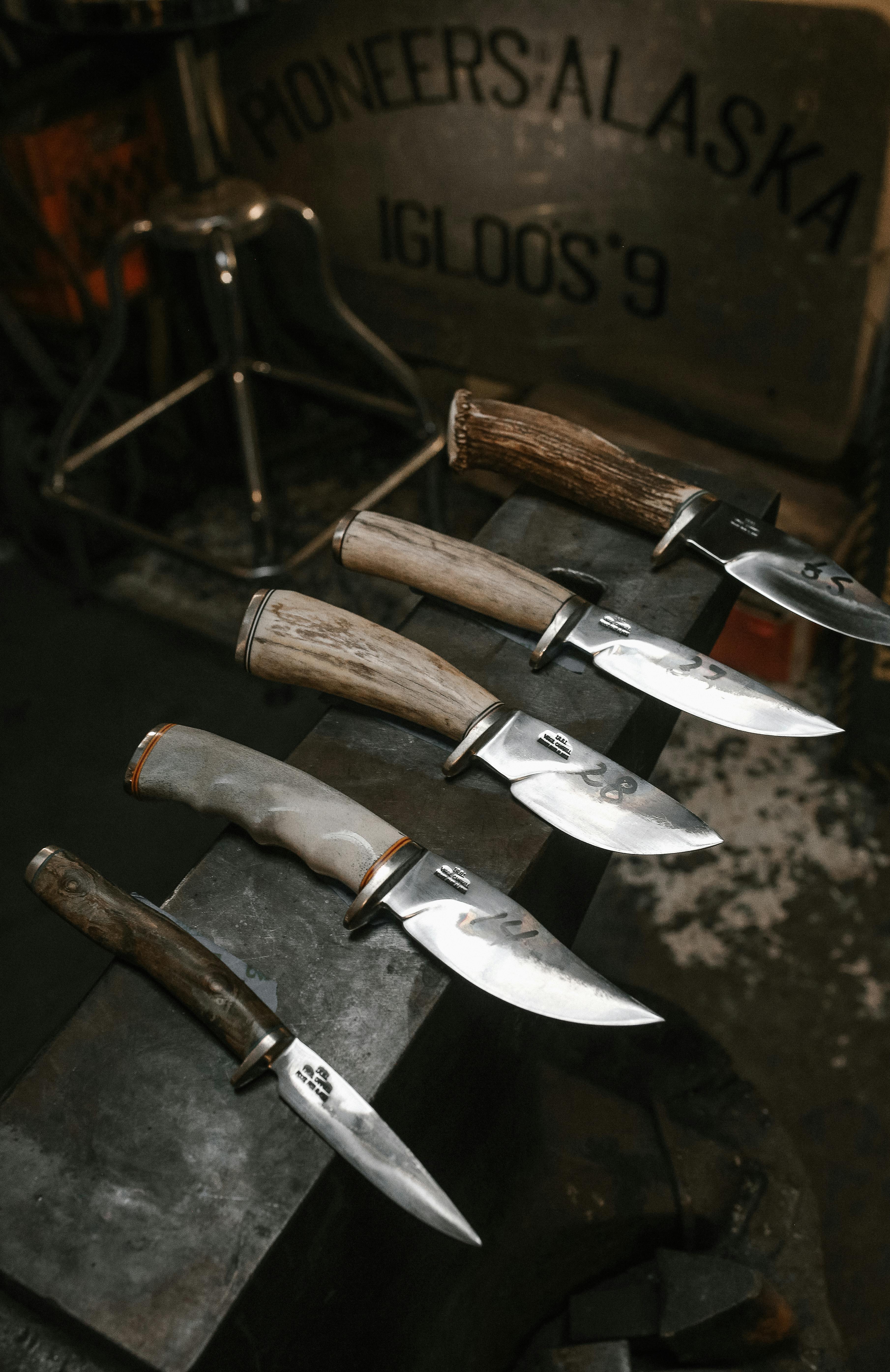
Five handcrafted knives with antler and wood handles resting on a steel anvil in a forge workshop

A Craftsman's Journal

Iron & Edge Knifemaking from the Beginning

One man's honest record of learning the ancient art of the blade — starting with nothing but a hacksaw, a file, and a will to learn.

The Beginning

Knifemaking from the Beginning

Today I set out on a course to seriously learn knifemaking.

I have "played at it" a few times, but haven't gotten serious with it. This page will serve as a record of what I learn and what I make.

I will, of course, begin as everyone begins — by creating a simple steel knife by stock removal. This is the foundational method: taking a flat bar of steel and removing material with hand tools until a knife emerges. No forge. No hammer. Just patience, steel, and a file.

For tools, I have a hacksaw, a file, and an electric drill. Nothing fancy. But every master bladesmith started somewhere, and these simple tools are enough to begin.

I will begin at the beginning. I certainly hope you find this enjoyable.

— Dwayne Brock, May 24, 2026

The Record

Journal Entries

24
May
2026

Setting Out in Earnest

Today marks the official beginning. I've dabbled before — picked up a file, traced a blade profile, then let it sit. This time is different. This journal exists to hold me accountable and to document the inevitable failures that lead to real knowledge.

The plan: stock removal with hand tools. The method requires no forge, no power grinder, and no specialized equipment beyond what I already own. A hacksaw shapes the rough outline. A file refines the bevel. A drill punches the handle holes. Simple. Hard. Honest.

First task is to acquire a suitable piece of steel and a design I want to attempt. More to follow.

25
May
2026

Materials Matter!

One day has passed and I already manages my first mistake. I started a knife with the wrong metal.

I have learned that the carbon content of steel matters. Steel must have a high steel content or it will fail to heat treat or hold an edge. One way to test this is using a grinding wheel. If the metal creates bright sparks, it can be used. If it creates long, dull sparks, it should be used for something else.

I have learned that for a beginner like me, 1084 and 1095 steel is best for a first knife or two, using stock removal. Knife blanks are easily available on Amazon and other sources for these types.

And that was my first mistake and learning experience.

The Craft

Three Paths to a Blade

01

Stock Removal

The beginner's forge: start with flat bar stock and file, grind, and cut until the blade emerges. No heat required. A direct test of patience and hand-tool skill. This is where the journey begins.

02

Forging

Steel heated to glowing orange and shaped under hammer blows. The traditional path — forge, anvil, and fire. The grain of the metal is moved and refined in ways a file never can. A future chapter.

03

Handle & Finishing

Wood, bone, antler, or micarta — the handle is where a blade becomes a tool. Shaping, fitting, pinning, and sanding a handle scales from simple to endlessly refined. Every knife needs one.

The knife is the first tool. Every civilization that ever was, made one. To make one yourself is to reach back through ten thousand years of human hands. — A thought on why this matters